For the sixth year, we attended the Farm Sanctuary's Celebration for the Turkeys in Watkins Glen, New York. Turkeys are funny, affectionate birds and each individual has a unique personality. Susie Coston, the Farm's National Shelter Director, shares ten things you may not have known about turkeys.
It's so fun to watch the birds as the guests of honor during this holiday that where so many are killed and consumed. After the ceremony, I was interviewed by YNN for a story that aired on Sunday.
George and Chris came out to the Farm with us this year. This was their second Celebration for the Turkeys.
We got to meet the precious and sweet Tweed (behind me) and his buddy - I think it is Arnold, who were rescued last year.
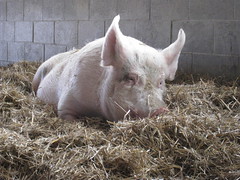
I also hung out with my adopted pig Eric. Here I am with Sebastian, Eric, and Jane.
"If we have the choice between doing something kind and doing something cruel, we should choose kindness. If we can do something merciful or something that adds to the level or misery in the world, we should choose mercy. And that’s a choice we make every time we sit down to eat."
George and I have been watching Game of Thrones and love Lord Tyrion, so I was happy to see that Peter Dinklage is this year's Walk for Farm Animals spokesperson!
In the time it takes you to read this post, nearly 10,000 chickens will be killed for food. The conditions in which they live are horrific. On factory farms, birds are confined in such small quarters, it would be similar to you living your entire life in the space of a folding chair. They are bred in such a way their poor little legs have trouble supporting their bodies, and often their beaks and feet are mutilated. Chicken factory farms and slaughterhouses also create significant pollution in their communities.
Chicken are empathetic, intelligent creatures who deserve better. Please think of chickens today, on International Respect for Chickens Day, and resolve to advocate for legislation that protects chicken.
Twenty-five years ago, the Farm Sanctuary began rescuing farm animals, educating the public about the horrific conditions on factory farms, livestock auctions and slaughterhouses, and advocating for laws that protect these wonderful beings. In March, they've set an ambitious goal of raising $50,000 to continue their important, lifesaving work. Please donate if you can!
“Do all the good you can,
By all the means you can,
In all the ways you can,
In all the places you can,
At all the times you can,
To all the people you can,
As long as ever you can.”
~John Wesley
A couple of weeks ago, Joan Jett (the pig) was Sanctuary Tail's Animal-of-the-Week! (Sanctuary Tails is a Farm Sanctuary blog written by the Farm's shelter directors.) I was so happy to see Joan featured. Not only is she adorable (she's the spotted pig), she is the pig that I sponsor through Farm Sanctuary's "Adopt-an-Animal" program.
Two major announcements regarding farm animal welfare provide some measure of celebration for animals in these trying times.
First, in Ohio, activists have been working to get a proposition on the ballot, much like those successfully run in Arizona and California. Instead of proceeding with the ballot initiative, Ohioans for Humane Farms (supported by the Farm Sanctuary, the Humane Society of the United States, and other animal advocacy groups) agreed to drop their campaign if the state's agricultural industry agreed to several reforms, including a ban on veal crates, a ban on gestation crates, and other measures (which are outlined in this Farm Sanctuary press release).
Second, according to an HSUS press release, today California's Governor Schwarzenegger signed a bill that requires by January 2015, all eggs sold in California
come from hens able to stand up, fully extend their limbs, lie down and spread their wings without touching each other or the sides of their enclosure, thus requiring cage-free conditions for the birds.
Otherwise, laying hens are kept in cruel battery cages. Imagine if you had so sit on a metal folding chair your whole life - you can't move, you can't stand, you can't stretch. That's what a battery cage is like. Kudos to Schwarzenegger for signing the bill into law.
As part of the Worldwide Vegan Bake Sale series of events, a vegan bake sale will be held this Saturday, June 27, on the Commons from 10:00 a.m. - 2:00 p.m. I hear there is a plethora of delicious vegan goodies lined up!
Proceeds will help Chuck Pappas, a former Farm Sanctuary employee who sadly had to quit his job last March after being diagnosed with Stage IV brain cancer. You would not believe how expensive treatment is, and how little of it is covered by insurance. We need to help Chuck get better so he can get back to helping the animals. Chuck's plight is detailed on the 300 miles for Chuck blog as well as Chuck's own blog.
Here are all the reasons why I do not use animal fibers when knitting. There are great alternatives like cotton, soy "silk," bamboo, and, for some, synthetic fibers. I've even seen some corn-based yarn!
Silk comes from the caterpillars of the silk moth, who protect themselves by spinning silk strands to form a cocoon.
Each worm may produce up to a mile and half of continuous thread. To retain an unbroken thread of silk, moths are commonly boiled, baked or steamed alive when they are ready to emerge.
The Alternatives Many common fibers simulate the look and feel of silk, including nylon, polyester, Tencel, milkweed seed-pod fibers, silk-cotton tree filaments, and rayon.
Wool
Angora
Angora rabbits are often kept in cramped cages for their entire eight-year lifespan.
Males only generate 75 percent of the wool females produce; consequently, most are killed at birth because they are not as "profitable."
The females typically endure lives of loneliness and boredom and suffer from painful bone deformities and other ailments caused by severe confinement.
Cashmere
Goats raised for cashmere are typically reared in filthy, crowded conditions.
Shorn months prior to their natural shedding time, the goats are often exposed to cold temperatures and become more susceptible to illness.
Goats are often ear notched, de-horned and castrated without anesthesia and sold for meat after their first fiber harvest.
Mohair
While a growing number of goats are being used for milk and meat in the United States, the majority are still used for mohair.
Intolerably sensitive to the cold and parasites, the goats often suffer from chills after their fleece is removed.
Like other animals used for fiber production, these goats are commonly sold for slaughter when they are no longer considered profitable.
Sheep's Wool
Sheep have been purposely bred to produce excessive wool. As a result of having an abnormal amount of wool, many sheep suffer from fly infestations, skin sores and wool parasites.
During shearing, the majority of these animals are handled roughly and their fleece is removed as quickly as possible. Injuries are common and shearers frequently cut into the flesh of terrified sheep.
Lambs typically suffer from painful mutilations, such as tail docking and castration, without anesthesia. Sheep may also undergo mulesing, a painful process by which a four by six-inch piece of skin is cut from their tails and backside.
When the sheep are no longer producing prime wool, they are commonly transported to slaughterhouses in overcrowded trucks. Many sheep become "downers" and are left to suffer and die slowly from neglect.
Australia, the largest wool producer, sends many of its "spent" sheep on a long, tortuous journey by ship to the Middle East where they are sold and slaughtered.
Felt, or compressed wool, is also a product of the cruel wool industry.
The Alternatives Instead of shopping for heavy, itchy wool socks and mittens or expensive angora or cashmere sweaters, choose garments made with more light-weight and colorfast materials, such as nylon, acrylic, orlon, polyester fleece, cotton flannel, synthetic shearling, Tencel, or Polartec Wind Pro.
The USDA has recently made a decision that allows companies to use a "naturally raised" label on their meat products, even if the animals were raised in horrific, confined conditions. This ruling misleads consumers and hurts the animals. Please tell the FDA that you would like them to reconsider this decision by signing a petition here.
The last time Gene Baur did a talk in Ithaca, we had visitors and couldn't go. I'm thrilled he's doing another presentation this month. Any Ithacans, please come and show your support of Baur and the Farm Sanctuary (pre-registration required)!
From the Farm Sanctuary:
Meet Gene Baur When his Book Tour Returns to Ithaca
Join us for an educational and inspiring event with Farm Sanctuary President and Co-founder Gene Baur as he discusses his best-seller, Farm Sanctuary: Changing Hearts and Minds About Animals and Food,at GreenStar Cooperative Market’s West-End Store in Ithaca, NY on Wednesday, April 15.
GreenStarwill host a book-signing and reading by Baur. Books will be available for purchase, and 100 percent of the author’s proceeds will be donated to Farm Sanctuary.
This event is free and open to the public upon registration, which is required for attendance.
When: Wednesday, April 15, 2009; Signing: 6 p.m.; Presentation: 7 p.m.
Where: GreenStar Cooperative Market, 701 W. Buffalo St., Ithaca, NY Registration: Inquire at GreenStar's Customer Service Desk or call 607-273-9392 to register.
Farm Sanctuary Backs Illinois Bill to Ban Bovine Tail Docking
Organization’s president calls painful animal management procedure “pointless mutilation”
WATKINS GLEN, N.Y. – March 9, 2009 – Farm Sanctuary, the nation’s leading farm animal protection organization, is urging passage of legislation in Illinois to ban the inhumane agricultural practice of tail docking cows on the state’s dairy farms. The farm animal advocacy organization is working with Senator Antonio Munoz, who recently introduced the bill (SB 1336) in the Illinois legislature and has recommended that the bill be assigned to a study sub-committee.
Tail docking involves amputating most of a cow’s tail, usually by applying a tight rubber ring around the appendage, which cuts off blood circulation until the tissue becomes necrotic. The tail then falls off one to four weeks later, or farmers may cut it off with heated shears. Despite the painful nature of tail docking, it is usually performed without analgesics.
“Tail docking is a pointless mutilation that causes animals both acute and lingering pain, especially when the wound gets infected,” noted Farm Sanctuary President and Co-Founder Gene Baur. “Science has disproven the myth that amputating most of a cow’s tail somehow improves hygiene or food safety, so it’s time for the dairy industry to stop disfiguring animals out of habit and convenience. Illinois can help lead the way by passing SB 1336.”
Dairy producers started cutting cows’ tails off several years ago because they believed it would prevent urine and feces stuck to the cows’ tails from getting on their udders and into milk, supposedly improving food safety and helping to prevent udder infections. However, peer-reviewed research from both governmental and academic sources indicates there are no health or safety benefits associated with tail docking. In fact, cows with docked tails suffer much greater distress during fly season because they are not able to disperse biting insects effectively.
Professional associations such as the American Veterinary Medical Association and the Canadian Veterinary Medical Association have issued statements opposing the procedure. However, despite the evidence that tail docking causes cows pain and does not accomplish what its proponents claim, the Illinois Farm Bureau is fighting SB 1336.
"I have requested the bill to ban 'tail docking' of dairy cows be assigned to a study sub-committee in order to achieve an in-depth review of this very important issue,” stated Senator Munoz. “Studies conducted, using rigorous scientific methodology, have raised some valid concerns of both humanitarian and human health issues. A study will provide the Illinois Senate the necessary time to examine this issue completely.”
Another bill to ban tail docking of dairy cows was introduced earlier this month in the California legislature by Senate Majority Leader Dean Florez, who has made animal welfare a top priority for the state Senate’s Committee on Food and Agriculture. While California and Illinois weigh whether to ban tail docking of dairy cows, countries like the United Kingdom, Switzerland, Sweden, Norway, and the Netherlands have already outlawed the practice.
“Cows are born with tails that have very clear anatomical functions, like swatting flies away and communicating with other cows,” argued Baur. “When a cow’s tail is removed, she literally loses a piece of who she is. It is cruel and unnecessary to cut off cows’ tails and the practice should be outlawed.”
I am writing to ask for your help. Farm Sanctuary’s Emergency Rescue Team has been in high gear over the past few weeks, and we need the support of friends like you to ensure we can continue to meet the needs of the abused and abandoned farm animals now in our care.
A fragile newborn goat was born at a stockyard. His mother was sold to the highest bidder and ripped away from him before this tiny 3-pound goat even had a chance to nurse. He was left to die in a cold, filthy stall ... within hours he was already suffering from hypothermia and a navel infection. Rescued by our humane officer and brought to Farm Sanctuary for emergency care, he is now fighting for his life at the Cornell University Hospital for Animals. And, he needs YOUR help. In his condition, he needs intensive care, vital nutrients and antibiotics. His will to survive is inspiring all who meet him. But, he has to overcome illness, infection and the cruel neglect he suffered during his first hours of life. Please give to the Emergency Rescue Fund today, and show him the care and love he needs after his harsh beginning.
In addition, Farm Sanctuary has just come to the rescue of a pregnant sheep abandoned on the side of a road in California. About to give birth, she was terrified, weak and unable to stand on her own. Just days after we took her in, the mother gave birth to two baby lambs. One of the lambs was born with underdeveloped lungs and was rushed to the University of California at Davis Veterinary Hospital to receive oxygen and antibiotics to have a chance at life. This mother - once abandoned with nowhere else to turn - and her newborn babies now need your help to survive.
Adding up to create a large influx of animals at our New York and California Shelters in a very short time, these rescues follow several other cases we’ve responded to, including 20 chickens rescued from a school “slaughter project,” a dairy cow named Faith saved from a 4-H project, 58 hens rescued from their battery cage prisons, and 66 turkey poults spared from becoming holiday dinners.
We urgently need your help to care for this large
group of animals given refuge at our shelters.
Many of the animals are struggling with health conditions and are in desperate need of special care.
Can you please make a donation to help fund the surgeries, medications, medical supplies, physical therapy, and other veterinary care needed to rehabilitate these animals? We also need assistance funding their feed, bedding and housing.
The animals at our shelters are given a second chance at life because of your support. It is your generous donation that makes the rescue of farm animals possible and gives them the care they need.
Your gift to the Emergency Rescue Fund at this very critical time will aid these very special individuals, who are counting on us for their survival. Your response will ease their pain and provide them with the comfort, care and happiness they deserve. Please, help these animals today.
Yours for the protection of farm animals,
Gene Baur
Farm Sanctuary President and Co-founder
P.S. Please make as generous of a donation as possible to the Emergency Rescue Fund so that these sweet animals, and all rescued animals, have a second chance at life.


 Angora rabbits are often kept in cramped cages for their entire eight-year lifespan.
 Goats raised for cashmere are typically reared in filthy, crowded conditions.
 Sheep have been purposely bred to produce excessive wool. As a result of having an abnormal amount of wool, many sheep suffer from fly infestations, skin sores and wool parasites.


