
Wednesday, July 7, 2010


"House Rules" by Jodi Picoult

 Recently, NPR recommended five books from the bestsellers of the previous six months, and on that recommendation, I decided to read House Rules by Jodi Picoult. I enjoy reading books in clusters - books about WWII, books about informed consent, etc - and Asperger's Syndrome (AS) has been a theme of my summertime reading. In Picoult's novel, Jacob, an eighteen year-old-boy, diagnosed with AS, has a razor-like focus on criminal forensics. He watches the fictional CrimeBusters (a nod to CSI) reruns daily and keeps detailed notebooks of the cases; he subscribes to academic journals on forensic science; and with the help of a police scanner, goes to crime scenes where sometimes his advice, though unwelcome, gives investigators the perspective they need. However, when Jacob's social skills tutor, Jessica Ogilvy, is reported missing, and then later found dead, Jacob is arrested for the murder. His Aspergian traits - flat affect, self-centeredness, single-minded focus on one topic, the need for a strict adherence to a set schedule, twitches (stimming), lack of eye contact, aversion to touch, and meltdowns - are read by many, including his family, as indication of guilt. (As far as I can tell from previous reading, Picoult is fair in her representation of AS; in her acknowledgements, she mentions that an AS teenager read a draft of the novel and gave her feedback, of course, in a frank and unflinching manner.)
The premise of the novel was intriguing to me, and, as I mentioned, Picoult was fairhanded (yet perhaps too pedantic) in describing AS. However, the execution was disappointing. First, I found the five main characters - Jacob, Emma, Theo, Oliver, and Rich - to be fairly unsympathetic. This did make me think quite a bit. I found it ironic that I had so little empathy for the characters, especially since a lack of empathy is characteristic of AS. I wondered if this was deliberate, so we could feel more of Jacob's world, or if it was sloppy writing that made the characters unidimensional. I don't have children, much less a child on the autism spectrum, but I found myself feeling sorry for Theo, Jacob's younger brother, who is forgotten in the wake of Jacob's needs. Emma, their (single) mother, seems unaware or unconcerned about Theo. This may be the way it is for families who have a member with AS, but it struck me as unfair. Second, each of the five characters has chapters corresponding to their points of view - and each of them had a unique font! I found this gimmicky and distracting. (An aside: I just started reading another book on NPR's list, The Lake Shore Limited
 , and while I haven't read much, I noticed it has the same structure: alternating chapters by character. Is this about the NPR list or about today's novels?) Each of the ten sections of the novel was introduced by a Case History - a crime solved using innovative forensic methods, with the final of the Case Histories discussing Jessica's death. I found this slightly gimmicky, too, but less distracting than the different fonts. Third, given the title of the book "House Rules" and the tendency of people with AS to obey rules, the mystery of the story is fairly obvious, though I was curious about how it would be revealed.
Despite my criticisms, this is a quick, engrossing read - good for the beach or a flight, though I'd wait until the book comes out in paperback.
Ellis Paul | 3,000 Miles
You can see why Ellis Paul is one of my favorites. Be sure to check him out at www.ellispaul.com. If you go to www.ellispaul.com/free you can download “Annalee,” the lead track of Ellis Paul's new album, The Day After Everything Changed, for free.
Here, he is singing with Susan Werner, who is also awesome.
Here, he is singing with Susan Werner, who is also awesome.
Tuesday, July 6, 2010
Some Good News for Animals
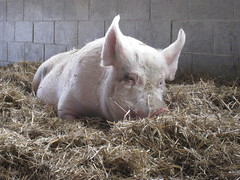
Two major announcements regarding farm animal welfare provide some measure of celebration for animals in these trying times.
First, in Ohio, activists have been working to get a proposition on the ballot, much like those successfully run in Arizona and California. Instead of proceeding with the ballot initiative, Ohioans for Humane Farms (supported by the Farm Sanctuary, the Humane Society of the United States, and other animal advocacy groups) agreed to drop their campaign if the state's agricultural industry agreed to several reforms, including a ban on veal crates, a ban on gestation crates, and other measures (which are outlined in this Farm Sanctuary press release).
Second, according to an HSUS press release, today California's Governor Schwarzenegger signed a bill that requires by January 2015, all eggs sold in California
come from hens able to stand up, fully extend their limbs, lie down and spread their wings without touching each other or the sides of their enclosure, thus requiring cage-free conditions for the birds.Otherwise, laying hens are kept in cruel battery cages. Imagine if you had so sit on a metal folding chair your whole life - you can't move, you can't stand, you can't stretch. That's what a battery cage is like. Kudos to Schwarzenegger for signing the bill into law.
"Bad Blood: The Tuskegee Syphilis Experiment" by James H. Jones

 After reading The Immortal Life of Henrietta Lacks, I was interested in other discussions of race and informed consent, so decided I wanted to learn more about the Tuskegee Syphilis Experiments. Usually, when I think of informed consent, my mind goes to Milgram's Obedience Experiments or Zimbardo's Prison Experiment. (One of my favorite classes at OU wasn't even for credit for my MBA program; it was an undergrad social psychology class I took for fun.)
Bad Blood was an edifying and interesting chronicle of the experiments, if at times horrific. James Jones did an excellent job describing the racial and social prejudices of the historical context without excusing them. Like Milgram and Zimbardo, there is some attention to the role of institutions and authority figures in perpetuating atrocities. One of the more interesting chapters discussed the role of Nurse Rivers, an African-American woman who was the primary link between the men in the experiment and the "government doctors." It is hard not to ask, How could she? Jones gives a convincing answer to the question, though he doesn't excuse her complicity. Also interesting were the descriptions of public health "demonstration" projects preceding the Tuskegee experiment. The Great Depression curtailed funding of many health programs, leading to the void into which the Tuskegee experiment fell, but when the country needed healthy young men to fight overseas, the health of the populace, especially men, was again a priority...except for the men of "Nurse Rivers' Burial Society" who were cruelly denied treatment for the sake of the study.
I would have liked more discussion of the men who were part of the experiment, though access may have prevented Jones from covering more of their personal stories. By the time he wrote the history, not surprisingly, many of the men had passed away. The 1993 edition I read included a follow up chapter that discussed the Tuskegee experiment in light of the AIDS epidemic. While the information is dated, I thought that chapter did a nice job explaining why so many African-Americans distrust the government and doctors.
Monday, July 5, 2010


Sunday, July 4, 2010
Happy Independence Day
"Liberty means responsibility.
That is why most men dread it."
~George Bernard Shaw,
Man and Superman, 1905
Man and Superman, 1905

Saturday, July 3, 2010
Silent Protest
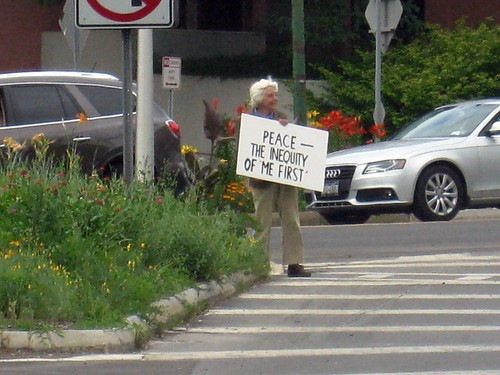
This woman is occasionally out by The Commons with signs supporting peace. I wonder if she is Quaker. I'm also a bit confused by her sign from last week - wouldn't PEACE be eliminating the inequity of "me first," not equal to it? But I am very literal. I hated the speeding signs in Oklahoma that said "Watch Your Speed We Are" because of the lack of clarity due to missing punctuation. Ah, but I digress. Sometimes, I honk and wave at this woman, but this time, I was too busy taking her picture.
Friday, July 2, 2010
Today's Doctor Who-ism
"The way I see it, every life is a pile of good things and bad things... hey... the good things don't always soften the bad things; but vice-versa the bad things don't necessarily spoil the good things and make them unimportant."
~The Tenth Doctor
Thursday, July 1, 2010

Subscribe to:
Posts (Atom)
